
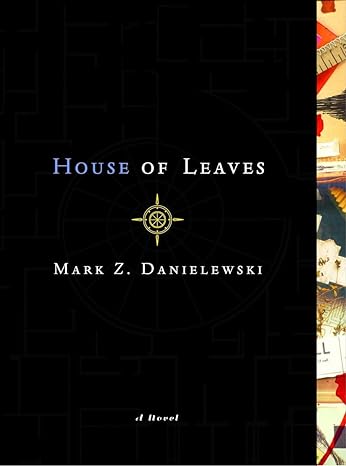
Note: I recently read the book House of Leaves by Mark Z. Danielewski and I wanted to write something about it. I know this is a photography page, but I didn’t really have anywhere else to put it, so…here it is. Spoilers ahead, of course, and I highly recommend this book, so feel free to skip it if you’re interested in reading it. If you have read it, though, I’d love to hear your thoughts on it so leave a comment and let me know.
Mark Z. Danielewski’s House of Leaves isn’t just a book—it’s a puzzle, a maze, and, most of all, a study of obsession and mental illness. At first glance, its disorienting layout—with pages filled with footnotes within footnotes, text running in every direction, and sections intentionally left blank—seems overwhelming and chaotic, however, as you progress through the narrative, it becomes clear that this isn’t just a stylistic choice for the sake of confusion—Danielewski’s layout reflects the mental states of the characters. The structure of the book itself mirrors the shifting, labyrinthine corridors of the house on Ash Tree Lane and the unraveling minds of those who become obsessed with it. Through its experimental form, the novel invites readers to experience the same sense of disorientation and claustrophobia that its characters face, forcing us to confront the unknown just as they do.
House of Leaves operates on three narrative layers. The first layer is Will Navidson’s story, in which he creates a documentary film about his family’s move into a house with impossible architecture. The second layer is told through Zampanò, an enigmatic blind man who writes an exhaustive academic analysis of Navidson’s film, complete with footnotes, references, and scholarly interpretations. Finally, there’s Johnny Truant, who stumbles upon Zampanò’s manuscript after his death and takes it upon himself to organize and complete it. As Johnny edits the manuscript, he becomes increasingly obsessed, using the footnotes to document his own mental deterioration. These three layers—Navidson’s film, Zampanò’s analysis, and Johnny’s editorial journey—intertwine to create a complex, multi-dimensional narrative that reflects the book’s broader themes of obsession and mental illness.
In House of Leaves, the impossible house represents much more than a physical space—it becomes a metaphor for mental illness and the endless corridors of the mind. Through its experimental structure and its play with form, the book explores how different individuals confront the unknown—whether it’s through emotional avoidance, intellectual obsession, or paranoia. This analysis dives into the major themes and characters of House of Leaves, especially as it relates to the struggle to overcome mental illness.
The House as a Metaphor for Mental Illness
At its core, the house on Ash Tree Lane is a perfect stand-in for mental illness. Just as mental illness can feel incomprehensible and ever-changing, the house defies logic and physics. It shifts, grows, and transforms, making it impossible for Navidson—and the reader—to truly understand. The dimensions of the house are unstable: bigger on the inside than the outside, with endless corridors that seem to stretch into infinity. This reflects the unpredictability of the human mind, especially when it becomes unmoored from reality.
For Johnny Truant, the manuscript itself becomes his personal “house,” mirroring his mental deterioration. Johnny’s discovery of Zampanò’s manuscript sparks a spiral into paranoia and obsessive behavior. His footnotes start as tangents but soon evolve into a personal diary, revealing his growing instability. The more Johnny immerses himself in the manuscript, the more his mental state mirrors the impossible geometry of the house. His fear of mental illness, stemming from his mother’s institutionalization, haunts him throughout the book, and the manuscript serves as a stand-in for whatever real-world factors are pushing him toward breakdown—be it trauma, genetics, or chemical imbalance.
In contrast, Zampanò’s obsession with the house is more clinical and detached. He intellectualizes the mystery of the house, breaking it down through footnotes, academic references, and endless analysis. His relationship with the house is one of intellectual compulsion, reflecting how some people attempt to control their mental illness by analyzing and compartmentalizing it. Yet, much like Johnny, Zampanò remains trapped. His endless dissection of the Navidson Record doesn’t lead him to any concrete answers—it only deepens his obsession. In this way, Zampanò’s obsessive analysis mirrors the limits of intellectualizing mental illness. No matter how much he analyzes the house, he can’t make sense of it.
Obsession and Its Consequences
Obsession is a central theme in House of Leaves, and it’s not just the house itself that represents this. Each of the main characters is defined by their obsession with something unknowable—and it leads them all toward the brink of destruction.
Will Navidson, the documentarian who becomes fixated on filming and exploring the house’s impossible dimensions, turns his home into a personal expedition. As a photojournalist, Navidson is used to capturing and controlling the world through his camera lens. But the house refuses to be contained in this way. The deeper Navidson goes into the house’s endless corridors, the more he loses touch with reality. His use of video diaries and cameras becomes a way of framing his experience, but it’s also an attempt to impose order on the chaos around him. Ultimately, Navidson’s obsession nearly costs him his life and the lives of those around him.
Johnny Truant’s obsession with Zampanò’s manuscript is equally destructive. From the moment he discovers the work, Johnny becomes consumed by it, to the point that he stops sleeping, eating, and interacting with the outside world. He begins using the footnotes as a personal journal, and it’s here that we see the full extent of his paranoia and mental deterioration. What starts as curiosity quickly devolves into a full-blown breakdown, mirroring how mental illness can take hold when left unchecked.
Then there’s Zampanò, whose obsession with analyzing Navidson’s footage forms the foundation of the novel. His detailed analysis, rife with references to books and articles that Johnny can’t even find, suggests that Zampanò is creating a world of academia around something that may not even exist. In this way, Zampanò’s obsession is different from Johnny’s or Navidson’s—it’s not the house itself, but the idea of the house, that consumes him. His obsession reflects the way some people attempt to confront mental illness through intellectualization, constantly trying to understand something that may be fundamentally incomprehensible.
Character Analysis: Johnny, Zampanò, and Navidson
Each of these characters interacts with the house—and with mental illness—in distinct ways. Let’s break down how each of them represents a different facet of obsession and unraveling:
- Johnny Truant is the emotional core of the novel. His narrative is fragmented, filled with paranoid rants and reflections on his traumatic past. Johnny is afraid of becoming like his mother, whose letters detail her own struggles with paranoia and psychosis. His descent is marked by a refusal to seek help—he turns away from Thumper, a woman who might have grounded him, and instead isolates himself. Johnny’s fear of mental illness is clear, but it’s also inevitable: by the end of the book, he is entirely consumed by his obsession, trapped in his own mind.
- Zampanò, the blind academic, takes the opposite approach to Johnny. His relationship with the house is cold, clinical, and analytical. Zampanò dissects every frame of the Navidson Record, breaking it down into academic essays and scholarly footnotes. Yet, there’s a madness to his method. Zampanò’s inability to verify the existence of The Navidson Report—and Johnny’s subsequent failure to find any proof of the film—suggests that Zampanò’s analysis may be based on a fabrication. His obsession doesn’t bring him any closer to understanding the house; it only traps him in an endless loop of analysis.
- Will Navidson is the most grounded of the three, but his journey is still one of descent. As a documentarian, Navidson’s instinct is to capture reality through his cameras. But as the house shifts and expands, it becomes clear that no amount of documentation will ever capture its true nature. Navidson’s obsession with filming the house mirrors his need for control—but ultimately, he must rely on Karen, his partner, to pull him out. It’s Karen’s emotional strength and love that anchor Navidson and allow him to escape. While Navidson survives, he is left scarred, both physically and emotionally, by his experience.
Conclusion
House of Leaves is a labyrinth of a novel, one that invites readers to get lost in its corridors of obsession, mental illness, and trauma. Whether you view the house as a metaphor for the mind or as a literal space that defies physics, the novel raises profound questions about the nature of reality, knowledge, and the limits of human understanding. Through the lenses of Johnny, Zampanò, and Navidson, the book explores how individuals confront the unknown—whether through emotional avoidance, intellectual analysis, or obsessive documentation.
At its heart, the novel suggests that the path to survival often requires both clinical support and emotional connection. Navidson survives because he has Karen to pull him back, while Johnny and Zampanò remain trapped in their respective obsessions. The house might represent mental illness, or it might represent something even more terrifying: the incomprehensible chaos that lies just beyond the limits of our understanding.

 Rabbit Branch Photography
Leave a comment